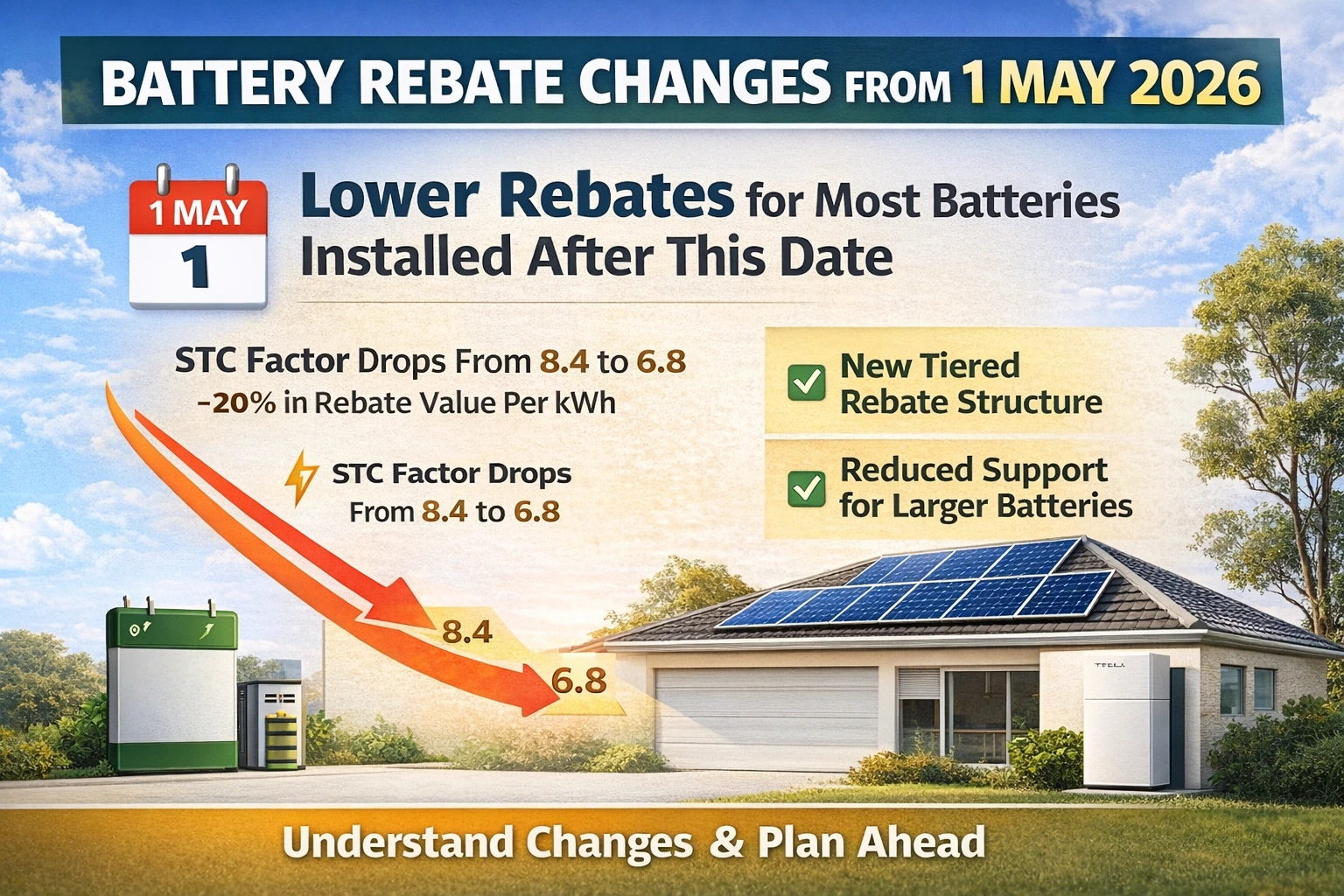
From 1 May 2026, battery rebates across Australia have officially changed not just in value, but in how they’re structured.
If you’re planning a battery, this is the key update:
The rebate is no longer applied evenly across the entire battery size.
Instead, it now follows a tiered structure, which means the first portion of your battery receives the highest benefit, and the rest is discounted at lower rates.
How the Battery Rebate Works from May 2026
The rebate is still based on usable battery capacity (kWh) under the Small-scale Renewable Energy Scheme (SRES).
However, from 1 May 2026, the incentive is applied in tiers.
Here’s how it works:
- First 14 kWh: Full rebate
- → About $3,200 to $3,800 total (after admin costs)
- 15 to 28 kWh: Around 60% of the rebate value
- 29 to 50 kWh: Around 15% of the rebate value
- Above 50 kWh:
- → No rebate applies
What This Means in Real Terms
This structure changes how larger battery systems are supported.
Example: 14 kWh Battery
- Receives the maximum benefit per kWh
- This is why systems around this size remain the most common
Most households will still fall into this bracket. If you’re unsure what size suits your home, read this guide: Which Solar Battery is Right for Your Home?
Example: 20 kWh Battery
- First 14 kWh → full rebate
- Remaining 6 kWh → reduced rebate (around 60%)
👉 You still receive a strong rebate, but not at the same rate across the full system.
Example: 30 kWh Battery
- First 14 kWh → full rebate
- Next 14 kWh → ~60% rebate
- Remaining 2 kWh → ~15% rebate
👉 The total rebate increases, but each additional kWh is worth less.
Example: 50 kWh Battery
- First 14 kWh → full rebate
- 15 to 28 kWh → ~60% rebate
- 29 to 50 kWh → ~15% rebate
👉 This is the maximum rebate range available under current rules
Why the Government Has Introduced This Structure
This change is designed to:
- Encourage right-sized battery systems rather than oversizing
- Spread incentives across more households
- Gradually reduce reliance on subsidies as battery adoption increases
It’s also aligned with the broader phase-down of the SRES scheme toward 2030. Learn more from the Clean Energy Regulator’s official solar batteries guidance
What Size Battery Gets the Best Value?
Under this structure:
- Around 10 to 14 kWh receives the strongest rebate per kWh
- 15 to 28 kWh still offers good value, but slightly reduced
- Above 30 kWh becomes more about energy needs than rebate optimisation
👉 In simple terms: The bigger the battery, the lower the rebate per additional kWh.
Important: Eligibility Rules Still Apply
To access the rebate:
- The battery must be connected to a solar system
- It must meet Australian standards
- Installation must be completed by an SAA-accredited installer
These rules remain unchanged.
Are Batteries Still Worth It in 2026?
Yes, but the conversation has shifted.
Instead of chasing the largest rebate, homeowners should focus on:
- Choosing the right battery size for their usage
- Ensuring compatibility with their solar system
- Considering backup power and VPP participation
You can also explore how batteries perform during outages.
The rebate still reduces upfront cost just not as aggressively for larger systems.
Final Thoughts
The 1 May 2026 changes mark a clear shift in how battery rebates are applied in Australia.
- Incentives are now tiered rather than flat
- Smaller systems receive the strongest support
- Larger systems still qualify, but at reduced rates
For most households, a battery in the 10 to 20 kWh range continues to offer the best balance between rebate value and real-world performance.
Need Help Choosing the Right Battery Size?
If you’re unsure what system size makes sense for your home:
- Compare battery options
- Understand how the rebate applies to your setup
- Get quotes from up to 3 SAA-accredited installers