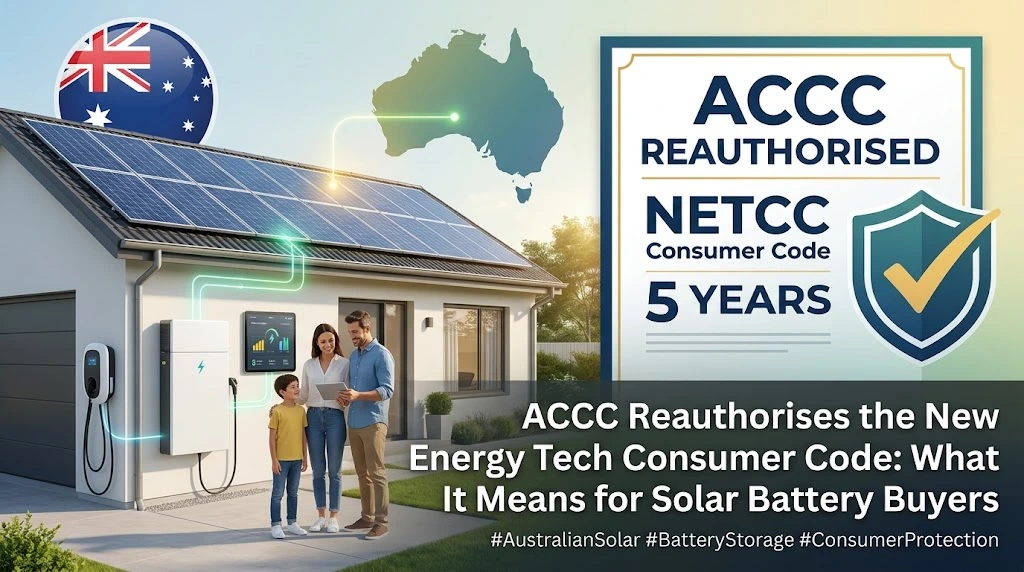
Australia’s home battery market is growing rapidly, giving more households the opportunity to store solar energy, reduce their reliance on the electricity grid and potentially lower their energy bills. But as more consumers invest in batteries and other new energy technologies, making sure they are properly protected has become increasingly important. On 28 August 2026, the Australian Competition and Consumer Commission ACCC reauthorised the NETCC (New Energy Tech Consumer Code) for another five years
The decision is significant for Australian households considering solar batteries, solar systems, EV chargers and other new energy technologies. The NETCC establishes minimum standards for participating suppliers when dealing with consumers.
For anyone considering a home battery, the announcement is also a useful reminder that choosing the right installer and comparing battery quotes carefully matters just as much as choosing the battery itself.
What Is the New Energy Tech Consumer Code?
The New Energy Tech Consumer Code, commonly known as the NETCC, is a voluntary industry code designed to establish consumer protection standards for businesses supplying new energy technology products and services.
The Code covers technologies including:
- Solar photovoltaic systems
- Home battery storage
- Electric vehicle chargers
- Virtual power plants
- Other emerging energy technologies
The NETCC was introduced in 2023 by the Clean Energy Council , replacing the previous Solar Retailer Code of Conduct. It is administered by the Clean Energy Council and currently has more than 2,300 signatories.
The program is designed to promote fair and responsible practices throughout the customer journey, from advertising and sales through to quoting, installation, warranties and customer service.
For battery buyers, this can provide an additional layer of confidence when dealing with a participating supplier.
Why Has the ACCC Reauthorised the NETCC?
The ACCC’s authorisation is important because businesses participating in the Code agree to follow common industry rules and standards. Those arrangements can raise competition-law considerations, which is why ACCC authorisation is required.
After assessing the Code, the ACCC concluded that it provides a public benefit but also identified areas where consumer protections could be strengthened.
The ACCC specifically highlighted concerns around:
- The lack of independent dispute resolution
- Reliance on self-reported audits
- Limited transparency around Code breaches
As a result, the ACCC has granted authorisation subject to conditions intended to strengthen the way the Code operates.
The authorisation will remain in place for five years. The current version of the Code will also continue for a further three months to allow the transition to the amended Code.
What Does the NETCC Mean for Battery Buyers?
Buying a home battery is a major investment. The system needs to be correctly sized, installed safely and matched to the household’s energy needs.
The NETCC is intended to help improve consumer protection across this process.
For example, participating suppliers are expected to follow standards covering areas such as sales and marketing, quotes and contracts, installation, system performance, warranties and complaints.
This matters because battery systems can be complex. Two quotes can appear similar at first glance while offering very different products, warranties, installation arrangements and expected performance.
The ACCC has previously highlighted the difficulty consumers can face when comparing offers and understanding complex contracts.
That makes it particularly important for homeowners to look beyond the headline price when comparing battery quotes.
The ACCC Says Consumer Protections Need to Keep Pace
The ACCC’s decision comes at a time when battery adoption is accelerating across Australia.
In July 2026, the ACCC reported that more than 400,000 home batteries had been installed across Australia in the previous 12 months.
The same report found that households with solar and battery systems had electricity bills that were approximately 20% to 52% lower over a year than households relying on electricity from the grid alone.
However, the ACCC also reported a 107% increase in consumer reports about household batteries and new energy services over the previous 12 months.
Reported problems included unsuitable systems, faulty installations, poor battery performance and difficulties getting issues resolved.
This highlights an important point: a growing battery market needs strong consumer protections alongside responsible purchasing decisions.
Does NETCC Approval Guarantee a Good Battery Installation?
Not necessarily.
The NETCC is a voluntary industry code, and ACCC authorisation does not mean the ACCC itself administers or enforces the Code.
The ACCC has explicitly stated that it has no role in developing, administering or enforcing the NETCC.
Instead, the Code provides standards that participating businesses agree to follow.
Consumers should therefore still do their own research, compare quotes and carefully review contracts before purchasing a battery.
NETCC participation can be one factor to consider when assessing a supplier, but it should not be the only factor.
What Should You Do Before Buying a Home Battery?
If you’re considering installing a battery, don’t rush into a decision based solely on a discounted price or a salesperson’s estimated savings.
A better approach is to:
- Understand your household’s energy usage.
- Determine how much battery storage you actually need.
- Compare multiple battery quotes.
- Check the battery’s usable capacity and warranty.
- Review exactly what each installation quote includes.
- Check the supplier’s credentials and NETCC participation.
- Ask about expected performance and savings.
- Read the contract carefully before signing.
- Understand any VPP agreement before handing over control of your battery.
- Keep copies of your quote, contract, warranty and installation documents.
Taking these steps can help you compare your options more confidently and avoid choosing a system simply because it has the lowest upfront price.
What the NETCC Reauthorisation Means for Australian Battery Buyers
The ACCC’s decision to reauthorise the NETCC for five years reinforces the importance of consumer protection as Australia’s home battery market continues to expand.
The Code provides a framework for participating businesses to follow minimum consumer protection standards, while the new conditions introduced by the ACCC aim to improve transparency and oversight.
But consumers still have an important role to play.
Whether you’re looking for your first home battery or comparing an existing solar system with battery storage, getting multiple quotes and understanding exactly what you’re paying for can help you make a more informed decision.
The right battery is not necessarily the cheapest one. It is the system that fits your household’s energy needs, budget, usage patterns and long-term goals.
Ready to Compare Battery Options?
If you’re considering a home battery, comparing quotes from different providers can help you understand the available systems, installation costs, warranties and potential savings.
GetBatteryQuotes can help you compare your options and take the next step towards finding a battery system that suits your home.